-
Your cart is currently empty.
The Untold Story
- March 11, 2026
Proudly made in the USA
The leader in flyrod innovation


In the spring of 1994, Mike McCoy received a call from Daryl Whitehead. Whitehead had been following McCoy’s fly-tying work in magazines and books and believed he had the patience and attention to detail required to become an accomplished fly rod builder. That conversation began a journey that has continued for more than 31 years later.
From the beginning, McCoy recognized a simple but critical truth: guide weight affects the performance of even the best-designed fly rods.
At the time, McCoy noticed that the industry relied on only two wire diameters to produce the full range of guide sizes. He believed that approach was limiting rod performance. His solution was to match wire diameter to guide size according to each guide’s location and function on the rod blank. The progression became:
This approach allowed energy from the rod blank to transfer more efficiently and improved overall performance.
McCoy’s next innovation was to radius the tops of the guide feet, reducing the distance from the top of the foot to the rod blank. The result was a lower-profile guide with better integration into the rod’s overall design.
A year later, he refined the concept further by tapering the guide feet, creating a smoother transition as thread ramped onto the top of the foot. That change improved both the rod builder’s wrapping experience and the finished appearance of the rod.
In 2004, McCoy conducted a detailed evaluation of the guides then available for graphite and fiberglass blanks. He identified numerous deficiencies, along with significant opportunities for improvement. His objective was direct: develope guides that would reduce alignment labor, lower guide weight, and improve overall rod performance.
In 2005, McCoy was granted U.S. Patent No. 6,851,216 for the Universal Guide, a major industry breakthrough. Its concave, radiused feet created a self-homing, self-aligning guide that reduced build time while improving alignment precision.
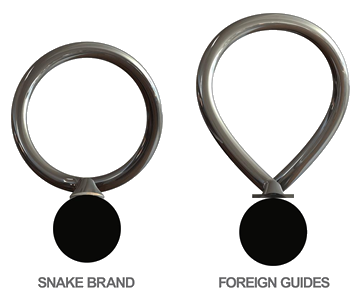
In 2009, he was granted a patent for a single-foot guide. By that time, McCoy had already recognized that the teardrop-style designs commonly produced in Asia and Brazil negatively affected line speed, casting distance, and accuracy.
For years, many U.S. fly fishers and casters had accepted imported teardrop guides as the best option available. Snake Brand rejected that assumption. With a more visionary, performance-driven approach, McCoy developed a rounded-loop guide that departed fundamentally from the teardrop form that had dominated the market. To produce that design to his standards, he also engineered a micro-welding machine specifically for producing guides to Snake Brand's standards.

Snake Brand’s innovation successes did not stop with guides. McCoy continued looking for ways to optimize fly rod performance, and tip tops became an obvious area for needed improvement.
The tip tops then available in the industry presented several recurring problems:
There was also a practical drawback: knots and connections could snag in the “V” of a teardrop guide, costing anglers fish. Once superior designs became possible, there was no reason to continue accepting those compromises.
Snake Brand also built a record of innovation through guide series designed for both bamboo and composite rod manufacturers. One notable example began with a call from Jim Barchi, President of Scott Fly Rod Company. Barchi described a new rod concept—the Radian—and asked whether a lightweight guide series could be developed specifically for it.
McCoy told him, “Let me think about it overnight, and I’ll call you tomorrow.”
By the following day, McCoy had developed a solution: a guide series using .024" wire for sizes #1/0, #1, #2, and #3, and .026" wire for size #4. That design contributed to the launch of one of Scott’s most successful rod series.
What might seem like a small adjustment had meaningful performance implications. The lighter guide configuration helped lighter-line rods recover more quickly, reduced oscillation during the cast, and improved delicate presentation. Before that development, the industry had offered no comparable solution for light-lined rods.

As spey rods gained popularity, manufacturers needed a guide series built specifically for the demands of that category. McCoy responded by developing heavier guides engineered expressly for spey applications. New dies were produced, heavier wire was sourced, and forming machines were reprogrammed to manufacture the series.
Over the years, Snake Brand Guides has continued to set industry benchmarks through creativity, innovation, and a disciplined focus on performance. Across every product category, the guiding principle has remained the same: optimize the energy generated by the casting stroke.